 TrailFox
By age
25 Nature Activities for Preschoolers (Zero Prep Needed)
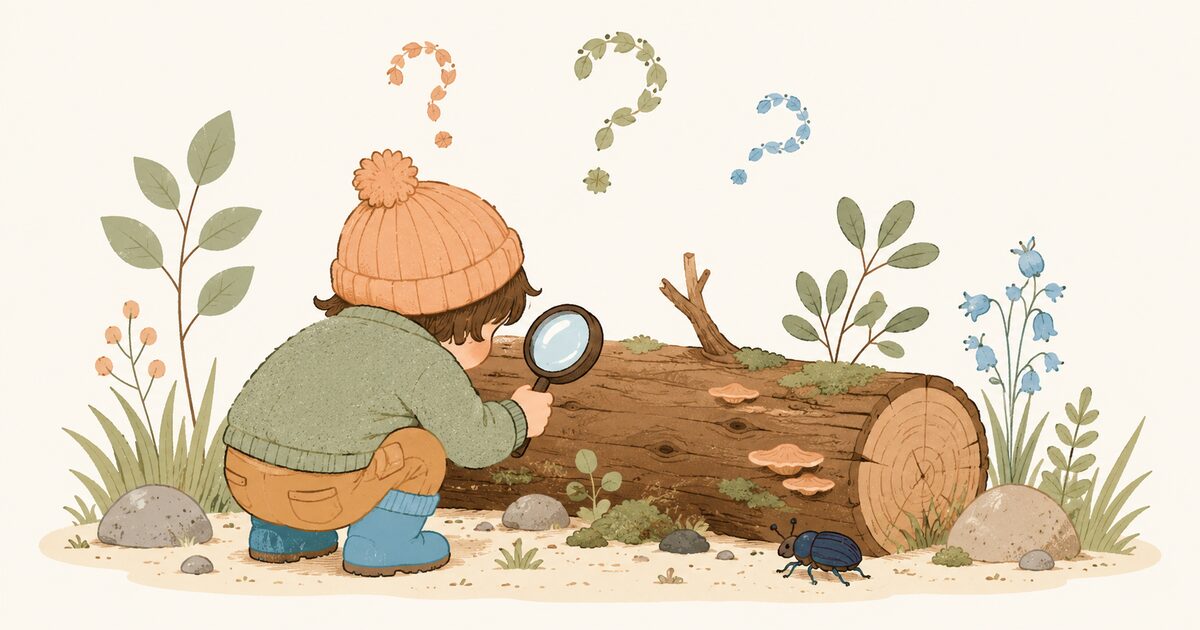
Somewhere around three, the questions start. Why do worms come out when it rains? Where do clouds go? What's under that? Why? Why though?
Most activity lists treat preschoolers as generic "kids". But 3-4 is a specific, glorious phase: peak curiosity, a new love of jobs and roles, and just enough patience for a quest — as long as the quest is shorter than their attention span. Nature activities for preschoolers work best when they plug straight into that: questions to investigate, jobs to perform, and small worlds to rule.
Twenty-five ideas, no prep, no printer, no equipment.
Question quests
Take one of their own "why"s and make it the afternoon's mission. You're not teaching; you're investigating together.
- Where do the worms go? After rain, follow one. Watch it work. Discuss its plans. (Current best answer: "down".)
- What's under the bark? Gently peek under a loose piece on a fallen log — woodlice city, usually. Roof goes back on afterwards, because that's the rule.
- Which way do the clouds go? Lie down, pick a cloud, track it against a chimney. Discover wind has a direction. Minds: blown.
- What do ants do all day? Find a trail and follow the commuters. Where's the office? What are they carrying? Why is that one going the wrong way?
- Where does the puddle go? Mark a puddle's edge with a stick after rain, come back tomorrow. The mystery of the shrinking puddle runs for days.
Nature jobs
Preschoolers will do almost anything if it's an official role. Issue titles generously.
- Official Bird Counter. Counts every bird on the walk. Reports totals. Robins are worth double, by decree.
- Puddle Depth Inspector. Assesses every puddle with the official measuring stick (a stick). Files verdicts: "splashy", "very splashy".
- Stick Sorter. Collects sticks, sorts by size into the Small, Medium and Enormous departments. Deeply satisfying work.
- Seed Collector. Acorns, helicopters, conker-season treasure — gathered, pocketed, sorted at home. See our autumn guide for the September version of this job.
- Path Clearer. Moves fallen twigs off the path "so nobody trips". Civic duty, aged three.
🦊 A pocketful of quests
TrailFox is a free app full of exactly this: question quests and nature missions matched to your child's energy and wherever you are. The Minibeast Safari pack is the preschool favourite — a whole deck of tiny-creature adventures. No ads, no subscriptions.


Small worlds
At this age the imagination is fully online. A tree root is a doorway now.
- Fairy doors. Hollows, knots and gaps between roots. Knock gently, leave a leaf calling card, check for replies next visit. (There are sometimes replies. We don't make the rules.)
- The minibeast safari. Lift one stone or log slowly: who's home? Woodlice, a beetle, the occasional celebrity centipede. Observe, wonder, lower the roof gently.
- Moss gardens. A mossy stone is a tiny park. Furnish it: pebble benches, a twig flagpole, a petal pond. Landscape architecture, preschool division.
- Acorn tea party. Acorn cups, leaf plates, mud cake, distinguished guests (snails welcome). The catering is imaginary; the fine motor skills are real.
- The tiny kingdom census. Who lives in this hedge? Name them all. Draw up the guest list for the hedge's birthday. This can run for weeks.
Big body nature
Because a preschooler who's only pottered will still be feral at bedtime. Full menu in how to tire out a toddler — these are the nature-flavoured picks.
- Log balance beams. Every fallen log, arms out, dismount with a flourish. Judges award full marks.
- Hill rolling. Down like a sausage, up like a mountaineer, repeat to exhaustion (theirs, ideally).
- Tree hugging, competitive. Measure trees in hugs. Hunt the two-hug giant. Update the record book.
- Run like weather. Storm! (thunder stomps) Breeze! (gentle drifting) Hurricane! (all limbs) Snow! (slow-motion float). Exhausting and meteorological.
- The stick relay. One stick must travel from the big tree to the bench, one runner at a time. The stick insists on speed.
Quiet nature
For the last five minutes, or the low-battery days — the noticing games that build the actual naturalist.
- The listening minute. Stand still, count the sounds. Woods and parks are louder than they look.
- Cloud menagerie. Every cloud is an animal with a name and an errand. The classic, undefeated.
- The texture hunt. Rough, smooth, fluffy, crunchy, tickly — a scavenger hunt for hands. More like this in our no-printable scavenger hunts.
- The smell tour. Grass, rain on pavement, flowers, someone's dinner. Preschool smell-reporting is devastatingly honest.
- Watch one bird. Pick a bird, watch until it flies off. What was it doing? Where's it gone? Write the story on the way home.
The secret ingredient is you, crouching
None of these need knowledge, equipment or a plan. They need an adult willing to crouch down at the worm and mean it. Preschoolers catch curiosity like colds — be interested out loud and they'll be interested for both of you. And when the answer to "why?" is beyond you: "I don't know — let's find out" is the best sentence in parenting.
For the full library sorted by garden, park, street and woods, start with the big toddler guide — and let TrailFox hold the ideas so you can hold the wellies. If you want the woodland version, or the forest school approach without the fees, we have both: woodland activities for children and forest school at home.
Quick answers
What are good nature activities for a 3 year old?
Anything with a question, a job or a small world: following worms after rain, being the official bird counter, building fairy doors, sorting sticks by size, or a slow safari under one lifted log. At three, curiosity is the engine — the activity just points it somewhere.
How do I get my preschooler interested in nature?
Be interested first, out loud — crouch at the worm, wonder where the cloud is going. Preschoolers catch curiosity like colds. Giving them official jobs (puddle inspector, seed collector) works better than instructions, because a role is a game and an instruction is a chore.
What nature skills should a 4 year old have?
None, formally — curiosity is the skill. If a 4-year-old notices things, asks why, and treats small creatures gently, they are exactly on track. Names of trees and birds are lovely extras that arrive on their own when noticing comes first.
What nature activities work on rainy days?
Rain improves most of them: worms surface, snails commute, puddles appear and everything drips. Worm rescue patrols, snail safaris and puddle-depth inspections are rainy-day exclusives — dress for it and the wet days become the favourites.
Do I need to know plant and bird names myself?
No — "I don't know, let's find out" is one of the best sentences in parenting. It models curiosity over knowledge, and at preschool age an invented name ("the noodle mushroom") plus genuine wonder beats a correct label delivered flat.