 TrailFox
Nature journal
Start a Family Nature Journal Your Kids Will Actually Fill
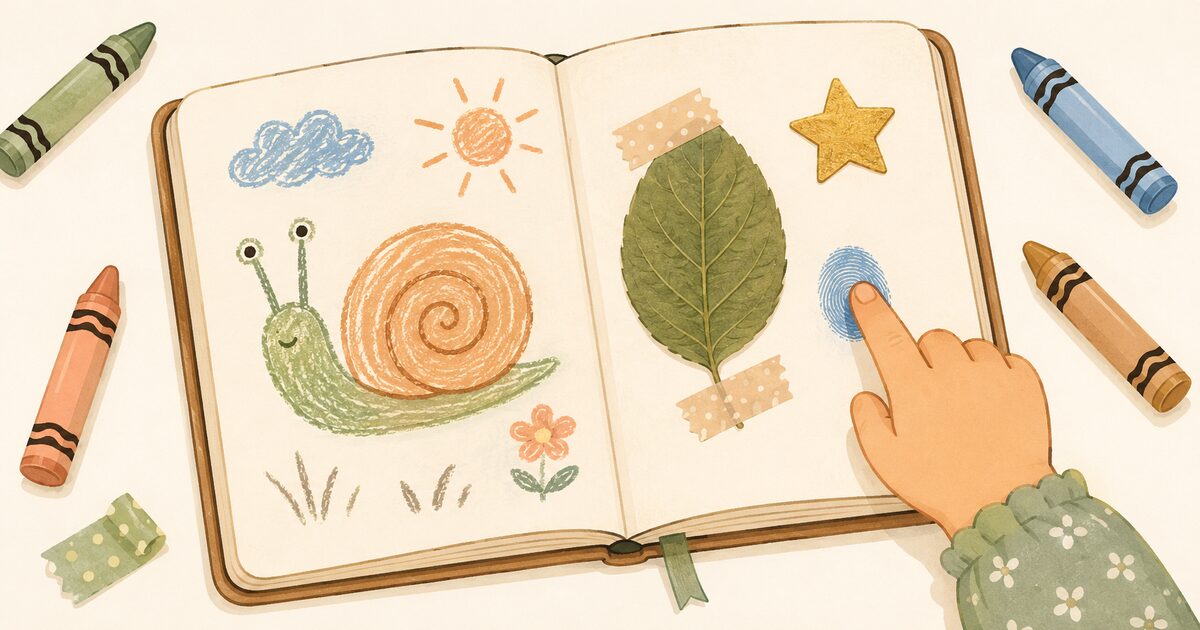
Every family nature journal has the same first page: dated, neat, full of hope. A pressed leaf, maybe. Lovely handwriting, because it was you writing it.
And most have the same page four: blank. Week three arrived, life happened, and the journal joined the sourdough starter in the museum of abandoned family projects — leaving behind a little guilt every time you see it on the shelf.
Here's the diagnosis, from a family that abandoned two before cracking it: nature journals fail when they're the parent's project — tidy, dated, worthy, complete. They succeed when they're the kids' treasure record: messy, sporadic, and mostly about one specific worm.
What actually goes in one
Not specimens. Moments.
- The bug under the log — and crucially, who spotted it first (this matters enormously to the spotter)
- The den that took all afternoon, photographed before the wind got it
- The first conker of the season, an event on par with a birthday
- The snail that got a name (RIP Gary, presumed relocated)
- What it smelled like, sounded like, felt like — the senses are the entry
A complete entry is: the thing, who found it, one detail. Ten seconds. The moment you find yourself writing a paragraph in your own handwriting, you've taken the journal back — return it to the children immediately.
Paper or phone?
Both work, honestly. Paper is tactile and lovely — crayon rubbings, taped feathers, mud smudges that become part of the record. It's also rained on, left at home, and (see above) abandoned by week three because the moment of the find and the location of the journal rarely coincide.
A phone journal inverts that: it's in your pocket at the exact second the woodlouse appears, the photo takes itself, and the entry is done before the woodlouse leaves. The one thing it can't hold is a taped feather. Plenty of families run both — phone for capture, paper for rainy-day craft sessions with the printed highlights. The only test that matters: which one will your family still be using in month two?
🦊 TrailFox has the pocket version built in
The family nature journal inside TrailFox does photos, notes, stickers, and — our favourite bit — records who spotted each find and which sense they used. Each child gets their own explorer profile, and everything syncs across your devices, so both parents can add entries. It's free, with no ads and no subscriptions.


Five rituals that make it stick
- The one-thing rule. Each outing, one thing goes in the journal — the day's champion find, chosen by the children. One. The limit is the feature: choosing the champion becomes a debate they care about, and the journal never becomes a chore.
- The spotter credit. Every entry names who saw it first. This transforms the journal from an archive into a scoreboard, and small people are highly motivated by scoreboards. Expect disputes. The disputes are engagement.
- The sense question. At entry time, ask: what did you hear? What did it feel like? What could you smell? One sense per entry is plenty — it's the difference between "saw a bird" and "heard a bird arguing". (The sensory scavenger hunts feed this beautifully.)
- The rainy-day look-back. This is the ritual that locks it in. On a filthy afternoon, open the journal together and tour the back catalogue. Kids demanding to see their own history — "show me MY snail!" — is the moment the journal becomes theirs.
- The sticker verdict. End each entry with a small ceremony: a sticker, a star, a drawn medal. Ceremony is glue at this age. The preschool why-phase in particular will not permit an entry to close unstickered.
What not to do
- Don't correct anything. Spelling, drawing accuracy, the claim that the beetle was "as big as the car". The journal records their world, and in their world it was.
- Don't make it daily. Sporadic is healthy. Three entries in a muddy week, silence for a fortnight, a flurry in conker season — that's a living journal, not a failing one.
- Don't make it yours. The moment it's neat, it's dead. Your job is logistics and applause.
Start this weekend: go out with no plan except the one-thing rule — the big guide has thirty outing ideas if you need a spark — and let the first entry be whatever they crouch at. It will not be what you expected. That's the whole point of keeping the record. The journal earns its keep fastest somewhere with a lot to record, which usually means the woods.
Quick answers
What age can kids start a nature journal?
Any age — the format just shifts. A 2-year-old's journal is photos of their finds with your captions; a 4-year-old adds drawings and dictated stories; a 7-year-old starts writing entries themselves. The noticing starts long before the handwriting does.
What do you put in a nature journal for kids?
Moments, not specimens: the bug under the log, who spotted it first, the den that took all afternoon, the first conker of the season. Add a photo or scribble, who found it and which sense they used — that's a complete entry. Neatness is nowhere in the recipe.
Is a paper or app nature journal better for families?
Both genuinely work. Paper is tactile and lovely but gets rained on, left at home and abandoned by week three. A phone journal is always in your pocket at the exact moment of the find, takes photos instantly, and syncs so both parents can add entries. Pick whichever your family will still be using in month two — that's the only test.
How often should we add to a nature journal?
When something's worth keeping — and no more often. Sporadic is healthy: three entries one muddy week, nothing for a fortnight, a flurry in conker season. Daily-entry pressure is how journals become homework, and homework is how they die.
My child just collects things and won't record anything — is that OK?
Collecting IS recording — photograph the pocket haul on the doorstep and you've made today's entry in ten seconds. The urge to gather comes first; the urge to look back at the gathering arrives on its own, usually the first rainy afternoon you open the journal together.