 TrailFox
Big guide
Outdoor Activities for Toddlers: 30 Quick, No-Prep Ideas
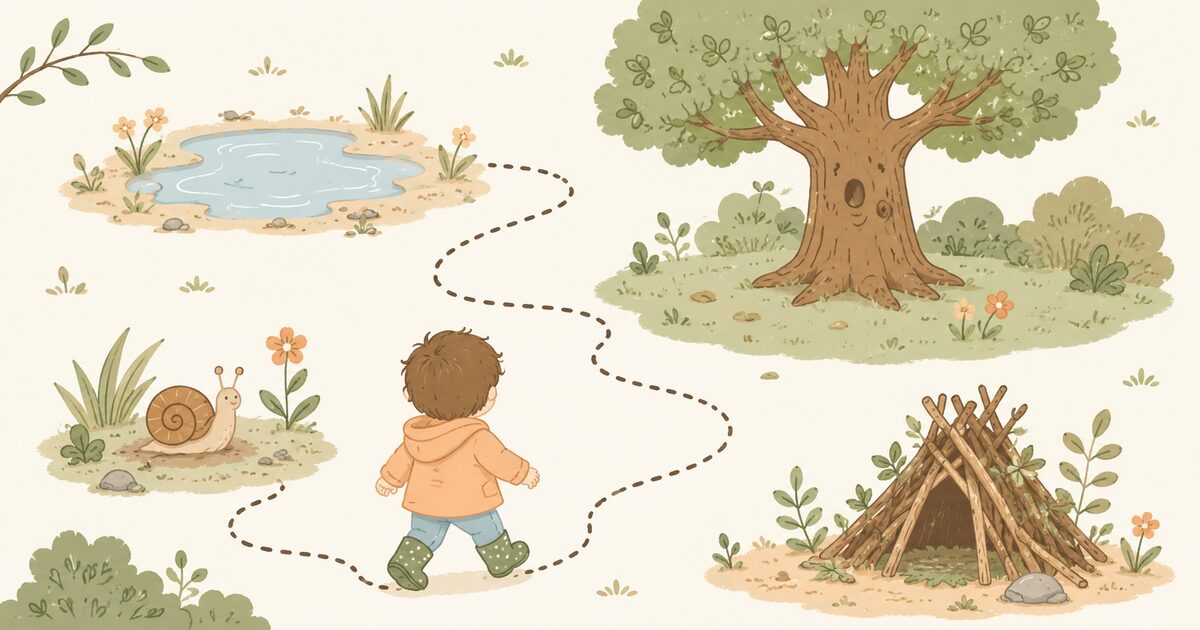
Here's the truth about outdoor activities for toddlers: the best ones need nothing. No printables, no pipe cleaners, no trip to a craft shop. A toddler plus outside is already 95% of the activity — your job is just the 5% spark of an idea.
This guide is thirty of those sparks, sorted the way real life sorts them: by where you're actually standing. Garden, park, street, or woods. Every single one can start within two minutes of reading it, uses whatever's already there, and works for roughly ages 2–5 (with honest notes where older or younger changes things).
In the garden (or yard, or balcony)
You don't need a big garden. Half of these work on a doorstep.
- Water painting. A cup of water and any old paintbrush. Toddlers "paint" the fence, the wall, the flowerpots. It dries, they do it again. This buys more minutes per unit of effort than almost anything in parenting.
- Snail watching. After rain, find a snail and follow it. Where's it going? What's it eating? Give it a name. Genuinely mesmerising for the under-5s.
- The washing-up bowl of wonders. Bowl of water, plus whatever: leaves, petals, a whisk, pebbles. It's a potion lab now.
- Welly toss. A laundry basket and a pair of wellies. Underarm, overarm, backwards through the legs. Keep score, or don't.
- Garden bingo, spoken aloud. "Find me something yellow… something tickly… something a bird would like." No printing — you're the bingo caller.
- Mud kitchen, zero build. An old saucepan, a stick to stir, a patch of earth, a splash of water. Michelin stars for mud pies. Ambitious chefs add petals.
- Doorstep picnic. Snack outside instead of inside. That's it. That's the activity. Toddlers treat it like an event.
- Bug hotel inspection. Lift a pot or a stone slowly and see who's home. Woodlice count as guests. Put the roof back gently.
At the park (beyond the swings)
The playground is great until the queue for the slide breaks someone's spirit. The rest of the park is empty and better:
- Treasure pockets. Agree five treasures before you set off: something round, something that smells, something older than Grandma, something a bird would like, something beautiful. Full pockets, full heart.
- Run like a… Shout an animal; everyone crosses the field like it. Cheetah, frog, crab, butterfly. Parents are not exempt, sorry.
- Tree hugging, competitive. Find the fattest tree in the park. Can you reach around it? Can two of you? Measure trees all over the park in "hugs".
- Cloud menagerie. Flat on your backs. Every cloud is an animal — name it, decide what it eats and where it's off to in such a hurry.
- Hill rolling. Find slope, roll down slope, climb slope, repeat. The oldest toddler activity known to science, and still undefeated for energy burn.
- Stick orchestra. Everyone finds a stick and a thing to (gently) tap: railings, a bench, a log. You are now a band. The dog walkers are your audience.
- Daisy-chain pit stop. A calm-down activity for the walk home — thread daisies while little legs recover. Fiddly for tiny fingers; they mostly harvest, you mostly thread.
🦊 This is exactly what TrailFox does — automatically
TrailFox is a free app that suggests outdoor activities matched to your kids' energy and where you are — garden, park, street or woods. Hundreds of ideas, no ads, no subscriptions. Stop scrolling lists (even ours) and let it pick.


Once you know which of these your child likes, the place-based guides go much deeper: garden games for toddlers for the ten steps out the back door, park games beyond the playground for when the swings stop working, and woodland activities for children if you have any trees within reach.
On your street (the walk that's actually an adventure)
No car, no kit, no destination required. The pavement is a venue:
- Front door safari. Ten doors down and back, spotting five tiny things you've never noticed: a mossy brick, a spider web, a painted gate, a dandelion in a crack.
- Landmark hop. Pick a landmark — postbox, big tree, red car — and travel there in silly ways: giant steps, tiptoes, robot walk, backwards (hold hands!).
- Colour walk. Today is a red walk. Find every red thing between here and the corner. Tomorrow: blue walk. This works for an entire rainbow of walks.
- Lamppost challenges. Between each pair of lampposts, a new move: hop, sprint, penguin waddle, whisper-count your steps. Twenty minutes to the postbox, pleasantly exhausted.
- Sound map. Stop. Close eyes. What can you hear — a bird? A van? A dog? Point at each sound with eyes shut. Thirty seconds of stillness, which for a toddler is a personal record.
- Crack-in-the-pavement botany. Hunt for plants growing where they shouldn't: walls, cracks, gutters. Toddlers root for the underdog weed every time.
- Puddle inspector. After rain, officially inspect every puddle on the street. Ripples must be tested. See our full rainy day activities guide for the wet-weather masterclass.
In the woods (maximum adventure)
A wood turns the adventure dial to eleven, even a small one:
- Stick den building. Twenty minutes to build a den a fox would be proud of. Big sticks first, leaves to fill gaps. Snacks inside the den taste scientifically better.
- Muddy footprint detective. Find prints — dog? bird? tiny dinosaur? Follow them, invent the animal's story, then stamp your own trail for the next detective.
- Lay a secret trail. Twig arrows on the path for someone to follow to hidden treasure. The treasure can absolutely be a biscuit.
- Fairy door hunt. Hollows, knots and root-arches are all potential fairy doors. Knock gently. Leave a leaf as a calling card.
- The listening minute. Stand dead still for one minute and count the sounds. Woods are louder than they look.
- Texture treasure hunt. Find something rough, smooth, fluffy, crunchy, tickly. A scavenger hunt for hands — more in our no-printable scavenger hunt guide.
- Log balance beam. Every fallen log is Olympic apparatus. Hold hands for the wobbly bits; dismount with a flourish; judges award full marks.
- Toadstool tiptoe. In autumn, tiptoe-hunt for fungi on stumps and logs. Eyes only, never touching — count shapes and colours instead.
The only three rules
- Clothes that can be ruined. A toddler in "nice clothes" is a toddler on a leash. Old coats, wellies, done. There's no bad weather, only unsuitable trousers.
- Twenty minutes counts. The Instagram version of outdoor play is a four-hour forest expedition. The real version is twenty minutes before tea that saves the whole evening. If they're bouncing off the walls, see how to tire out a toddler for maximum-burn options.
- Follow the toddler. If the plan was den-building but they've found an amazing worm, the activity is now worms. The worm was always the activity.
Why bother? (The two-minute pep talk)
You already know outdoor play matters — the NHS recommends toddlers get at least three hours of physical activity a day, and outside is where that happens without anyone refereeing over the sofa. Outdoor time is linked with better sleep, better mood and better everything else, but honestly the most compelling evidence is your own: compare a rained-in day with a day that included twenty muddy minutes. The data is conclusive.
The hard part was never believing it. It was standing at the back door at 3pm, out of ideas. That's the exact problem TrailFox exists to solve — tell it the energy level and where you are, and it hands you the idea. The thinking is done; you just supply the wellies. When you want to go deeper, the age guides split this list two ways: outdoor activities for 2 year olds for the handling-everything stage, and outdoor activities for 4 year olds for when rules and stories arrive. By place, the deepest one is woodland activities for children.
Quick answers
What is a good outdoor activity for a 2 year old?
The best activities for 2-year-olds involve pouring, carrying, copying and noticing rather than rules: water painting a fence, following a snail, filling a pot with pebbles, or a slow ten-doors walk spotting tiny things. At two, the game is the world itself — anything with rules or turns can wait a year.
How long should toddlers play outside each day?
NHS guidance suggests toddlers need around three hours of physical activity spread across the day, and outdoors is the easiest place to rack it up. It doesn't need to be one long session — two or three twenty-minute bursts count just as well, and twenty minutes before tea can rescue a whole evening.
Which outdoor activities need no equipment at all?
Almost all of them: puddle jumping, colour walks, cloud watching, hill rolling, stick dens, scavenger hunts you call out loud, footprint tracking and lamppost challenges all use only what's already outside. If you own wellies and a coat that can get muddy, you own the full kit.
What if we don't have a garden?
The street works brilliantly: front door safaris, landmark hops, colour walks, puddle inspections and lamppost challenges all happen on the pavement. A doorstep, yard or balcony supports water play, potion mixing and doorstep picnics. Outdoors starts one step past the front door, not at a forest.
What should toddlers wear for outdoor play?
Clothes that can be ruined: old coat, wellies, and in wet weather an all-in-one puddle suit — the single best purchase in toddler parenting. A toddler in nice clothes is a toddler on a leash; dress them for mud and every activity becomes available.